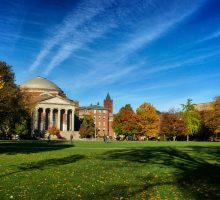

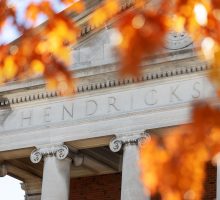
Hendricks Chapel is a gift from Senator Francis Hendricks, former Syracuse mayor and long-time Syracuse University trustee.
Senator Hendricks made provisions for the Chapel in 1920, and construction began in January, 1929. Pope and Baum, a New York architectural firm, designed the brick and limestone structure in a style that can be traced to the work of 16th century Italian architect Palladio, and to the Roman Pantheon. Hendricks Chapel was completed in September, 1930, and cost $600,000. The original organ was donated by the Senator's niece Miss Kathryn Hendricks at dedication ceremonies a month later.
Throughout the years, Hendricks Chapel has undergone a few changes. In 1952, the organ was replaced with an instrument built by Walter Holtkamp. In 1969, over $90,000 was spent adding a new suite for the Dean, six offices, two lounges, and a kitchen to the Chapel's working space. In 1980, the Rena Pierson Dankovich Chapel was donated, as well as vestments and religious articles serving the world's major faiths. On September 22, 1985, Hendricks Chapel was rededicated marking the completion of a five year restoration effort.
In 1999, a two phase renovation began which included the main office suite as well as the Noble Room. The Noble Room was equipped with new furnishings, a large screen projection system including internet access. A small stage area with lighting was created for lectures and performances. The room is also now equipped to display works of art.
History and Process
Hendricks Chapel opened its doors to the University community following construction (1929-30) in September of 1930. Thus, September, 2000, marks the completion of 70 years as the centerpiece of the campus. The Chapel has seen the University change from a private, relatively small, relatively homogeneous Methodist-related academy to the very large, heterogeneous, secular, private University it is today. Even so, the Chapel has been an experiment in diversity from the beginning. Donor Francis Hendricks called for a Chapel honoring his wife Eliza which would serve all faiths. Accordingly, the architects Pope and Baum used Greek and Roman themes in creating a space remarkable for its ambiance of sanctuary but almost completely without specific religious symbol. A worship center, still in use, has the flexibility to be used by any religious group wishing to do so, or as a backdrop for an academic or secular speech.
The style of operation of the Chapel has changed dramatically over the years. Even so, the focus on diversity, the emphasis on the importance of the spiritual aspects of life and its function as a religious, social, cultural, and intellectual gathering place have marked its history and its present.
How People's Place Started
People's Place was started during the spring of 1971, because at the time, "there was no area on campus where members of the SU community could come, buy some refreshments, and just relax," according to one of the first student coordinators.
From the beginning, it has been a student-run and non-profit operation, known for its warm and friendly atmosphere.
In its early days, People's Place sponsored other activities at Hendricks Chapel, such as story readings, yoga classes, and weaving and macrame classes.
Throughout its history, it has been a place where student managers and workers could gain experience running a non-profit operation serving a variety of important functions for the University campus.